Learn to think like a Rich Guy.
The 2007 Lemelson-MIT Invention Index found that teens believe they have developed only some of the critical skills that will be needed to address the problems of adult life. More than three out of four teens surveyed (77 percent) believe they have learned problem-solving skills at an above average level while in school. They also feel prepared to work in teams (72 percent), think creatively (71 percent) and lead others (61 percent). However, most teens surveyed believed that they fall short when it comes to budgeting money. Only 32 percent of teens said they feel they learned that skill well while in school.
While in a survey of about 1,000 13- to 18-year-olds conducted by StrategyOne for the Charles Schwab Foundation. 87% of teens said their main source for learning about money is their parents.
With few schools focusing on personal finance in the classroom, parents are their children's primary educators practically by default. Yet just 18% of parents said they discuss budgeting with their kids while 42% of parents said they have not taken any steps at all to discuss personal finance basics with their teens, according to a telephone survey of 500 teenagers ages 13 to 17 and 500 parents of such teenagers, conducted by Braun Research for Capital One Financial Corp.
For many parents, their own lack of knowledge hinders them from having the all-important budget talk. "I have parents tell me they'd sooner discuss sex than money with their kids," said Maureen Dolan Rosen, president of The Cash Management Connection, a publisher of budgeting workbooks for kids and adults, in Chapel Hill, N.C. "It's probably because they don't feel comfortable or confident in their own money skills. Maybe they've made mistakes along the way. They're not comfortable telling their kids how to do it if they don't feel they do it very well themselves," she said.
In the Schwab survey, 24% of teens said their parents lecture them about money but don't practice what they preach. That's not the best way to get lessons across. "Don't tell kids not to waste money if you're a profligate spender," Rosen said. Debt also seems to be an intrinsic part of teen life these days: 31% of the teens surveyed by Schwab said they owe money and half of them are concerned about being able to pay it back.
This concern about money only gets more critical as the survey respondents get older. Nearly 40% of 18- to 24-year-olds and 60% of 25- to 34-year-olds are concerned about having enough money for retirement. And of this younger set, 36% of 18- to 24-year-olds and 49% of 25 to 34-year-olds are actively planning on their own without the help of a professional financial advisor. While 59% of 18- to 24-year-olds said they saved for retirement in 2006, that number jumped to 89% who said they would save for retirement in 2007. Of 25- to 34-year-olds, 70% saved for retirement in 2006, while 85% indicated they will save for retirement in 2007. Americans in these younger age groups have lofty goals to reach: 39% of 18- to 24-year-olds and 39% of 25- to 34-year-olds want to have $1 million or more saved for retirement; 12% of 18- to 24-year-olds and 9% of 25- to 34-year-olds hope to have more than $5 million saved.
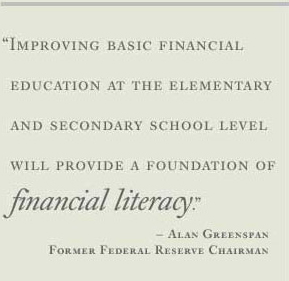
What is indicated by this wealth of research is that there is a critical need for financial literacy among pre-teen (tween) and teenagers that is not necessarily being best served by the education system or by their parental influencers. One of the problems is that the topic is not considered "cool" by most teens so it is not generally a topic of conversation among peers. This issue seems to be transcending generations.
Accounting software seller Quick Books recently surveyed approximately 1,300 small business owners with 20 or fewer employees to find out about their personal influences and their backgrounds. They found that 43 percent of entrepreneurs admit they were "loners" as kids, while 25 percent said they would have been described as "nerds." According to the Capital One Financial Corp Survey, 49% of teens say they want to talk about money management but have nobody to turn to.
These facts, together with a great deal of focus group testing conducted by the Institute for Advanced Practices in Advertising, led to the creation and development of GrowUpToBeRich.com. On this web site young people are introduced to "Jack," (Andrew Jackson) a rather outspoken animated twenty dollar bill with attitude, who has taken it upon himself to set kids straight about money.
Jack's strategy is deceptively simple. He tells his audience that if they want to grow up to be rich they have to start right now to "think like a rich guy." Through the use of simplified Flash animation, Jack and his wide variety of teaching aides bring home the basic lessons of economic literacy that starts with "Go out and get somebody to pay you to do something, right now," and winds up with, "To grow up to be rich you have to pick the one thing you love to do and become the absolute best at it. To get the best pay you have to do the best job at what you love."
In addition to straight talk explanations about how to think about money and build wealth, the site also seeks first-person videos from young entrepreneurs who are willing to share what their experience has taught them thus far about making, saving, and spending their own money.
Sponsorship Opportunities
GrowUpToBeRich.com is a financial services Brand Manager's dream come true. Jack begins his one-on-one dialogue with his young audience member in terms and language any teenager can identify with. For example: "I'm here to talk to you about money because nobody ever talks to you about money except to say that you can't have any." For the Adaptive Brand, the selling environment of GrowUpToBeRich.com provides the ideal atmosphere for reaching young adults who are truly concerned about their future and the impact that financial planning and management will have on that future.
The selling environment of GrowUpToBeRich.com is also the perfect place to reach parents who are more than likely to be the ones to will first review the site's content before passing it on to their teens, or will be informed by other parents who have discovered the change in their own offspring that has resulted from interacting with the site.
Although there is a great deal of wisdom in a potential sponsor taking on sponsorship of the entire GrowUpToBeRich.com domain, the site has been designed for multiple Adaptive Branding opportunities to be made available through the sponsorship of the more than twenty individual feature interactive content areas planned for the next two years as the site, the Audience, and the community of finance-oriented teens grows.
Those sponsorship areas planned for the first year are the chat room, forum, business opportunity listings, items-for-sale listings, services for sale listings, news feeds, video gallery, business startup tutorials, 101 Teen Business Ideas section and business library sections.
Accountability
The primary success metric associated with GrowUpToBeRich.com is the growth of "perception of Brand Value among Middle School to High School tweens and teens" market segment (along with their parents) when compared to other programs deployed against this segment. This metric can be measured by:
a) the number of requests for promotional items from GrowUpToBeRich.com or the sponsor's web site,
b) Sponsored study materials downloads or redemption for product trial samples, services or coupons at GrowUpToBeRich.com or the sponsor's web site,
c) unique visits to the sponsored sections of GrowUpToBeRich.com or the sponsor's web site for promotional program activities..
Each of these analytic programs is designed to align their metrics with Sponsor Business Calenders and promotional timelines.
Current Status
GrowUpToBeRich.com is currently under development for launch in July. |